Flipkart Listing Image Requirements - Full Size & Format Guide 2026
Flipkart Standards vs. Amazon
"Most sellers treat Flipkart as a copy-paste of their Amazon listing. Big mistake. Flipkart's catalog team reviews images manually for many categories, and what works on one platform can get rejected on the other."
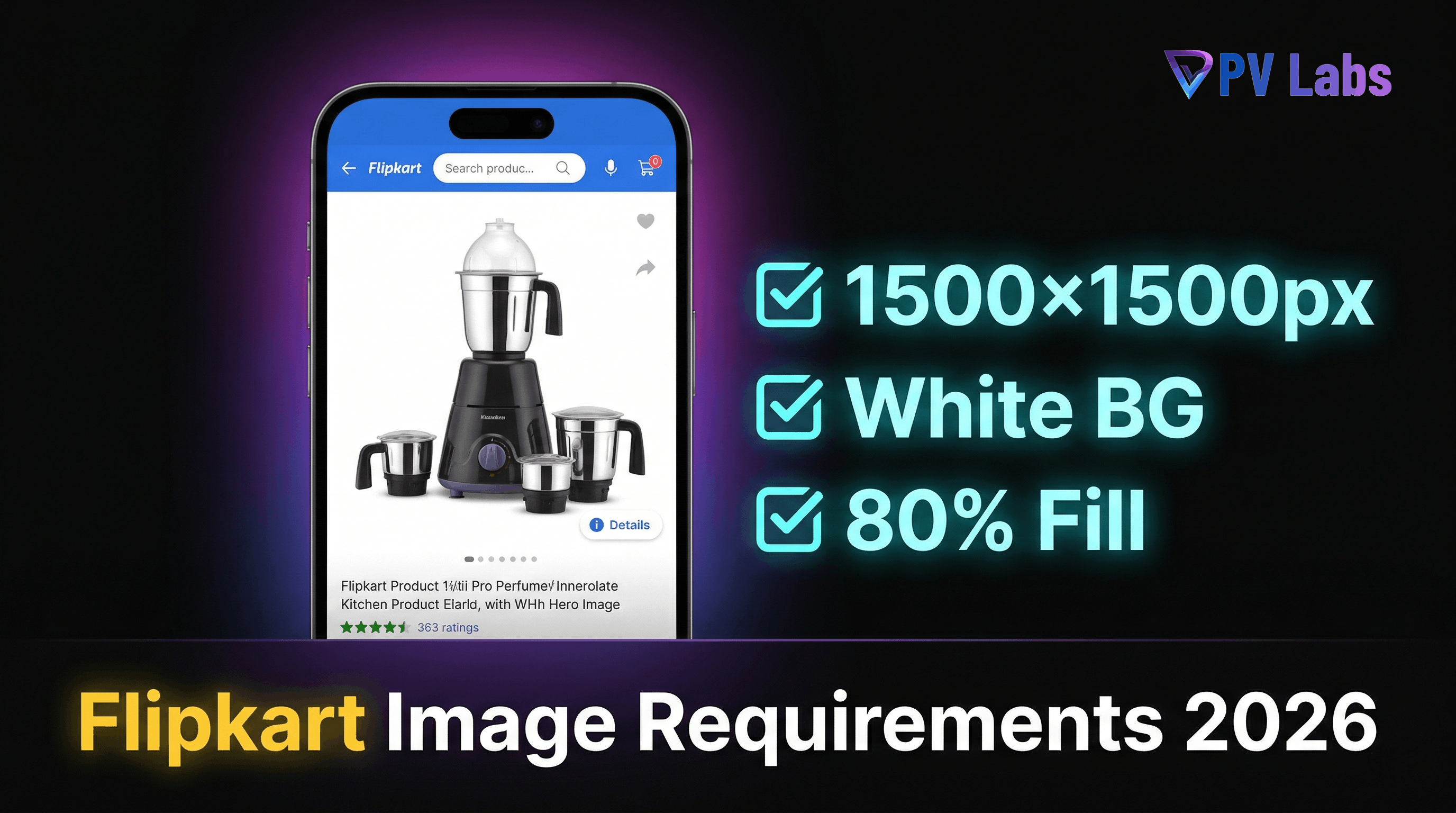
Technical Specs 2026
- Min Resolution1000 × 1000 px
- Recommended1500 × 1500 px
- BackgroundPure White (255,255,255)
- Product Fill80% Minimum
- FormatJPEG / PNG
How Many Images?
Flipkart's algorithm rewards listings with 6+ images. Clicks are significantly higher when buyers see the product from every possible angle.
Category-Specific Requirements
Fashion & Apparel
Front/back shots mandatory. Model images preferred over flat lays.
Home & Kitchen
Real Indian home settings. Dimension references are non-negotiable.
Electronics
All ports/buttons visible. In-the-box contents shot recommended.
Skincare & Beauty
Ingredient list must be visible. Certifications (BIS) build trust.
Food & Grocery
FSSAI license number and Expiry date must be clearly visible.
Baby Products
Age suitability and safety certifications clearly displayed.
Common Rejection Reasons
Off-white background
Even a slight grey or beige tint leads to instant manual rejection.
Product too small
System flags any product filling less than 80% of the frame.
Watermarks / Logos
Main image must be clean. No brand identity on the hero shot.
Low Resolution
Images under 1000px are auto-rejected by the Flipkart portal.
Inconsistent Style
Different lighting or backgrounds across SKUs kills trust.
Lifestyle as Hero
Main image MUST be white background. No exceptions.
Flipkart vs. Amazon Key Differences
Scroll table horizontally to view more →
Flipkart Image Checklist
Struggling with Flipkart listing rejections?
We create 100% Flipkart-compliant listing image sets with zero rejections guaranteed.
Get Flipkart-Ready Images →Why Flipkart Is Different from Amazon — And Why It Matters
Most Indian sellers list on both Amazon and Flipkart. And most make the same mistake: they upload identical images to both platforms. This is a problem because Flipkart and Amazon have fundamentally different catalog systems.
Amazon uses primarily algorithmic image review — their systems auto-check resolution, background color, and text. Flipkart, on the other hand, has manual catalog teams that review images in many categories, especially fashion, electronics, and home. A human reviewer is far stricter than an algorithm.
Flipkart also has different UI behavior. On the Flipkart app (which accounts for 80%+ of Flipkart traffic), images are displayed in a slightly different aspect ratio and zoom level than Amazon. Text that's readable on Amazon's viewer may become unreadable on Flipkart's. Color profiles render differently. What looks crisp on Amazon can look washed out on Flipkart.
At PV Labs, we create platform-specific image sets. Same product, optimized differently for each marketplace. This costs marginally more but eliminates rejections and maximizes conversion on both platforms.
Flipkart Image Specifications — The Complete Technical Guide
Here are the exact specifications Flipkart enforces in 2026, based on their latest seller documentation and our experience with 500+ listings:
Primary Image (Hero): Pure white background (RGB 255,255,255). Product must fill minimum 80% of the frame. No text, no logos, no watermarks, no props. JPEG or PNG format. Minimum 1000×1000px, recommended 1500×1500px. Square 1:1 aspect ratio mandatory.
Secondary Images: Up to 8 additional images allowed. These can include lifestyle shots, infographics, size charts, ingredient lists, and feature callouts. Text is allowed on secondary images but must be readable at mobile scale (minimum 24pt equivalent).
Fashion-Specific Rules: Front and back shots are mandatory. Model images preferred over flat lays or ghost mannequins. Size chart is compulsory for all clothing and footwear. Color accuracy is critical — Flipkart's QC team rejects listings where the displayed color doesn't match the actual product.
Electronics-Specific Rules: All ports, buttons, and connectivity options must be visible in at least one image. "In the box" contents shot is strongly recommended. BIS certification mark should be visible for applicable products.
Food & Grocery: FSSAI license number must be clearly visible in at least one image. Manufacturing date, expiry date, and nutritional information should be shown. MRP must be printed on packaging and visible.
Flipkart's Manual Review Process — What Actually Happens
Unlike Amazon where most image checks are automated, Flipkart employs catalog quality teams that manually review images in high-volume categories. Here's what their review process looks like:
Stage 1 — Auto Check: Flipkart's system automatically checks resolution (must be 1000px+), file format (JPEG/PNG only), and file size. Images that fail these basic checks are rejected instantly — you see the error in Seller Hub within minutes.
Stage 2 — Manual Review: For categories like fashion, beauty, electronics, and baby products, a human reviewer examines your images. They check: Is the background truly white? Does the product fill 80%+ of the frame? Are mandatory shots included (front/back for fashion, size chart for apparel)? Is there any policy violation (watermarks, competitor logos, misleading imagery)?
Stage 3 — Approval or Rejection: If approved, your listing goes live within 24–48 hours. If rejected, you get a reason code in Seller Hub. Common codes include: "Image quality not as per guidelines", "Background not white", "Mandatory image missing". You can resubmit immediately after fixing the issue.
The manual review is why Flipkart rejections are so common among Indian sellers. We've seen sellers get rejected 3–4 times before getting images right. With PV Labs, our Flipkart approval rate is 100% on first submission because we know exactly what the manual reviewers look for.
How Flipkart's Algorithm Rewards Better Images
Flipkart's search algorithm considers what they call a "Catalog Quality Score" — a composite metric that includes image quality, number of images, attribute completeness, and description quality. This score directly affects your search ranking.
Listings with 6+ high-quality images score significantly higher than listings with 2–3 mediocre shots. Flipkart's data shows that listings with complete image sets (all slots filled) receive 40% more clicks than listings with just a hero image and one or two secondary shots.
Flipkart also uses image quality for their "Flipkart Assured" and "Top Seller" badge eligibility. If your listing images don't meet quality thresholds, you're automatically disqualified from these trust badges — which significantly reduce buyer hesitation and increase conversion.
During Flipkart sales events like Big Billion Days, Flipkart Dussehra Sale, and Republic Day Sale — the algorithm gives even more weight to catalog quality. Sellers with professional images and complete catalogs get preferred placement in deal pages, flash sales, and category banners.
Flipkart Listing Image Cost in India — 2026 Pricing
What does it cost to get professional Flipkart-compliant images in India? Here's a realistic breakdown for 2026:
- • DIY (phone camera + Canva): ₹0 cost, but 40–60% rejection rate and poor conversion
- • Local photographer: ₹5,000–₹15,000 per SKU (not Flipkart-optimized, no infographics)
- • Freelancer (Fiverr/Upwork): ₹2,000–₹6,000 per SKU (hit or miss quality, no compliance guarantee)
- • PV Labs: Listing images cost ₹499/SKU for 10 SKUs; ₹449/SKU for 25 SKUs; ₹399/SKU for 50+ SKUs. Each package includes 5 listing images per SKU.
The hidden cost most sellers miss is rejection rework. Every rejection costs you 2–5 days of lost sales while you fix and resubmit. If your product does ₹2,000/day in revenue, one rejection cycle costs you ₹4,000–₹10,000 in lost revenue — more than the cost of getting it right the first time.
The catalog package includes 5 images per SKU for the agreed marketplace. If you need separate Amazon and Flipkart versions, contact PV Labs to confirm the additional scope and quote.
Flipkart vs Meesho vs Myntra — Image Requirements Compared
If you're selling on multiple Indian marketplaces, here's how their image requirements differ:
Flipkart: 1000×1000px minimum, white background, manual review in most categories, size chart compulsory for fashion. Strictest enforcement among Indian platforms.
Meesho: 800×800px minimum, white background preferred but not always enforced. More lenient review process. However, Meesho's buyer base is extremely price-sensitive — professional images create trust that justifies even small price premiums over competitors.
Myntra: Strictest of all Indian platforms for fashion. Model shots are mandatory (no flat lays, no ghost mannequin for most categories). Specific angle requirements: front, back, side, detail close-up. Images must show accurate color under neutral lighting. Myntra rejects more fashion listings than Flipkart and Amazon combined.
JioMart: Relatively new catalog requirements. 1000×1000px minimum, white background. Review process is evolving. Getting in early with professional images gives you first-mover advantage as JioMart scales.
At PV Labs, we create images optimized for all Indian marketplaces simultaneously. One photoshoot brief, multiple platform-specific deliverables. This is how smart Indian brands scale across Flipkart, Amazon, Meesho, Myntra, and JioMart without multiplying their design costs.